
How to Identify and Overcome Limiting Beliefs for Lasting Change

Kathy Khodi-Elhami
Transformational Subconscious Coach
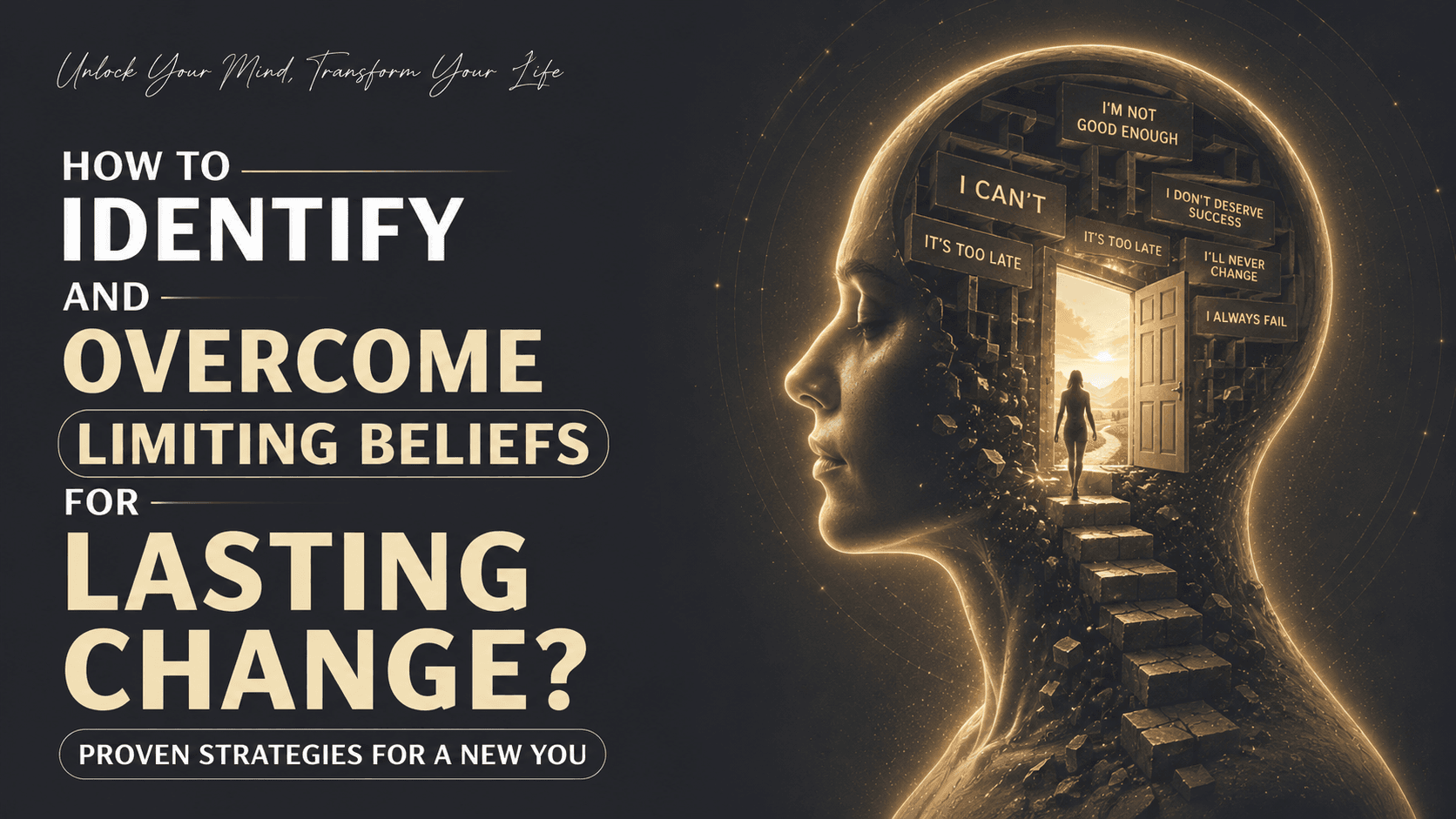
Why the belief you think you need to fix is rarely the one that is actually running you, and what to do about the real one.
You have probably googled something like 'how to stop self-sabotaging' or 'why do I keep repeating the same patterns.' Maybe you have read the books, tried the affirmations, written in the journal. Things shift a little. Then the same situation appears again.
That is not a motivation problem. It is not a discipline problem. It is a belief problem, specifically, a belief that is so embedded in your subconscious that your conscious effort cannot reach it.
That quiet voice has been shaping your results longer than you realize. This guide will help you find it, understand where it came from, and change it at the level where it actually lives.
Key Takeaways
- Limiting beliefs are subconscious conclusions that shape how you think, feel, and act, often without your awareness.
- Most limiting beliefs develop through childhood experiences, family influences, cultural conditioning, or significant emotional events.
- Repeating patterns in relationships, finances, career, or self-confidence are often signs of underlying limiting beliefs.
- Techniques such as resistance mapping, sentence completion, emotional trigger tracking, and results analysis can help uncover subconscious beliefs.
- Lasting change requires more than positive thinking; it involves identifying the root belief, addressing its emotional charge, and reinforcing new patterns through consistent action.
- Working with a coach or practitioner can be helpful when limiting beliefs are deeply rooted, connected to past experiences, or continue to drive recurring self-sabotaging patterns.
What a Limiting Belief Actually Is?
Most explanations of limiting beliefs make them sound like mildly negative opinions you hold about yourself. Fix your thinking, swap the negative for a positive, repeat until healed. That framing is too simple.
Your subconscious mind processes far more information than your conscious mind and relies on stored conclusions to interpret experiences and guide behavior. These conclusions operate automatically, often outside your awareness. Because the subconscious treats them as facts rather than opinions, limiting beliefs tend to feel true even when evidence suggests otherwise.
This is why lasting change can be difficult. You may consciously believe you deserve success, love, or abundance, yet continue repeating the same patterns. The conscious mind has changed its perspective, but the subconscious belief driving the behavior remains intact.
Limiting beliefs do not simply influence what you think. They influence how you perceive opportunities, make decisions, respond to challenges, and create results in your life.
Where Limiting Beliefs Come From
Understanding the origin of a limiting belief is not about assigning blame. It is about understanding why conscious effort alone cannot remove it. From birth to approximately age seven, the human brain operates predominantly in theta and delta brainwave states.
In adults, these states are associated with deep relaxation, meditation, and hypnosis; they are the states in which the subconscious is most receptive to new programming. Children are essentially in a continuous light trance. Information does not go through a critical filter before being stored. It goes directly in.
This is not a design flaw. It is how children learn language, culture, survival, and social belonging at remarkable speed. The same mechanism that allows a child to absorb a language in two years without instruction also absorbs every repeated message, every witnessed dynamic, every conclusion drawn from pain or rejection, and stores all of it as foundational truth about how the world works and who they are within it.
The four primary sources
- Family modeling: The unspoken rules of your household about money, love, success, and self-worth. Not just what was said explicitly, but what was demonstrated. Parents who worried constantly about money without saying a word about it installed a scarcity blueprint through their behavior and energy.
- Cultural and social conditioning: The collective beliefs of the community you grew up in. Religious frameworks, gender expectations, class narratives, cultural definitions of who succeeds and who does not. These are particularly powerful because they are rarely articulated as beliefs. They are simply 'how things are.'
- Significant emotional events: A single high-charge experience can install a belief instantly. Humiliation in front of peers. A parent's absence at a critical moment. A failure that was witnessed and commented on. The subconscious extracts a rule from the emotion: do not do that again, or protect yourself this way.
- Slow accumulation: Not every belief comes from a dramatic moment. Some beliefs formed through repetition so consistent that they became invisible. The child who was repeatedly interrupted came to believe their voice was not worth listening to, not because of one incident, but because of a thousand small ones.
How to Identify Your Limiting Beliefs: Five Specific Techniques

You cannot identify a subconscious belief by asking your conscious mind to produce a list of them. The conscious mind will give you a manageable, presentable answer that skims the surface. These five techniques work specifically because they bypass that filter.
1. Map your resistance, not your problems
Most people focus on the problems they want to fix: anxiety, money struggles, or relationship challenges. But these are often symptoms. The underlying belief is what creates the pattern.
A better place to look is resistance. Notice where you hesitate, procrastinate, or feel yourself pulling back. Resistance often appears when a subconscious belief feels threatened. When you encounter it, ask yourself: What does this part of me think will happen if I move forward? The answer often reveals the belief operating beneath the surface.
2. Sentence completion
This technique works by catching the subconscious before the critical mind can sanitize the response. Write out the following prompts and complete each one six to ten times, writing as fast as possible, without re-reading until you are done:
- 'Money is...'
- 'Successful people are...'
- 'If I let people see the real me, they would...'
- 'The reason I have not achieved [specific goal] yet is...'
- 'Love requires me to...'
- 'I could never...'
When you read back through your responses, look for two things: the completions that surprised you, and the ones you immediately wanted to cross out. Both are pointing at something real.
3. Work backward from your results
Your recurring results can reveal the beliefs driving them. Look at an area of life where you've stayed stuck despite genuine effort and ask: What belief would explain this pattern?
Then consider where that belief may have come from. What messages did you hear growing up? Did anyone in your family model the same pattern? For people who find self-reflection difficult, starting with visible results is often the easiest way to uncover the subconscious beliefs beneath them.
4. Track your emotional triggers precisely
Intense emotional reactions often point to an underlying belief. When the emotional response feels larger than the situation itself, there is usually a deeper story attached to it.
For example, someone else's success may trigger beliefs about scarcity or unworthiness. Discomfort with praise may reflect doubts about your own capabilities. Feeling abandoned when someone sets a boundary may reveal fears that your value depends on being useful.
To spot these patterns, keep a two-week emotion log. Each time a strong reaction arises, write down what happened, how you felt, and what you told yourself it meant. Over time, recurring themes can reveal the beliefs operating beneath the surface.
5. Use the gap question
This one comes directly from Kathy's practice. Sit with it honestly: "If failure was not possible and no one would judge you, what would you do differently starting tomorrow?"
Write the honest answer. Then look at the distance between that answer and your current life. Every inch of that gap is being held in place by a belief. The belief is not the gap itself. The belief is the story your subconscious has about why the gap exists and why it should stay there.
Surface Beliefs vs. Core Beliefs: Why This Distinction Changes Everything
A surface belief is domain-specific. 'I am bad at networking.' 'I always freeze in job interviews.' 'I cannot seem to hold onto money after I make it.' These are limiting, but they are contained. With the right combination of new experience, coaching, and behavioral practice, surface beliefs can shift relatively quickly.
A core belief is a statement about identity. 'I am not enough.' 'I am fundamentally flawed.' 'I have to earn my right to exist.' Core beliefs are not domain-specific. They express themselves across every domain simultaneously.
This is why someone can do extensive work on their money beliefs and see real improvement, then hit an identical ceiling in relationships, because both were expressions of the same core belief about worthiness. When you address only the surface, you are clipping branches. The root grows them back.
Kathy's work through the SoulPrint Method focuses first on identifying whether what is present is a surface belief or a core one because the approach to each is fundamentally different. Surface beliefs respond to techniques that introduce counter-evidence and new experience. Core beliefs require identity-level work, not replacing the belief with a better one, but dissolving the emotional charge beneath it and rebuilding self-concept from the ground up.
How to Overcome Limiting Beliefs: The Complete Process

This is not a five-step framework that produces results if you try hard enough. It is a description of what genuine belief change requires. Some of these steps you can do alone.
Others move significantly faster with professional guidance, particularly when the belief connects to early emotional experiences that carry significant charge.
Step 1: Name it with precision
Vague beliefs cannot be changed. 'I have confidence issues' is not a belief you can work with. 'I believe that if I step into full visibility, people will eventually discover I am incompetent and I will lose everything I have built', that is a belief you can work with.
The specificity matters because the belief is not generalized. It has a specific trigger, a specific fear, and a specific protection mechanism. The more precisely you can name it, the more clearly you can see where it came from and what it would take to dissolve it.
Step 2: Locate the origin
Ask: how old does this feeling feel when it gets activated? What was happening in my life the first time I drew this conclusion?
This is not about reliving pain. It is about putting the belief in its proper context, as a conclusion drawn by a younger version of you, with the information and emotional processing capacity available at that time. When you can see the belief as something a child concluded based on limited information, rather than as objective truth about your adult self, the belief's authority weakens. Not because you argued with it, but because you understood it.
Step 3: Dissolve the emotional charge
Many self-help approaches focus on changing thoughts, but limiting beliefs often persist even when you know they are irrational. You may recognize a belief is false, yet still feel its influence when a familiar trigger appears.
This happens because beliefs are often reinforced by emotional and physical patterns, not just conscious thinking. Lasting change requires addressing those deeper responses, not simply replacing one thought with another.
Techniques that work at the emotional and somatic level include:
- Subconscious reprogramming through guided hypnosis: Accessing theta state to work directly with the subconscious without the interference of the critical mind.
- Mental rehearsal with embodied emotional engagement: Not visualizing the outcome as an observer, but experiencing yourself inside it, with the felt sense of the new belief being true.
- Somatic anchoring: Connecting the new belief to a physical state, so the body begins to hold the new programming, not just the mind.
- Identity-based language: Speaking from the new belief as your current reality, not as an aspiration. 'I am someone who leads with clarity' rather than 'I am trying to be more confident.'
Step 4: Install the replacement at the subconscious level
A belief is not removed and left empty. It is replaced. The replacement needs to be installed with the same mechanism through which the original belief was formed: repetition, emotional intensity, and state-dependent learning.
This means working in the subconscious state, with emotional engagement, consistently over time. Not once a week in a session, but daily practice that conditions the new belief through repetition until it becomes the default, not the effort.
Step 5: Act from the new belief before it feels completely natural
Waiting until the new belief feels fully established before acting from it is one of the most effective ways to stall this process. The subconscious updates, in part, through behavioral evidence. When you take an action consistent with the new belief, before the old resistance has fully dissolved, you give the nervous system a new reference point.
Start small. The goal is not a dramatic gesture of transformation. The goal is accumulating small, consistent actions that build a new evidence file. Each one makes the next one slightly easier, because the subconscious is building a new pattern of 'this is what I do.'
The SoulPrint Method: What Makes It Different
The SoulPrint Method is based on the idea that limiting beliefs are layers of conditioning that can obscure a person's authentic identity. Rather than focusing solely on changing thoughts, the approach aims to identify and replace subconscious patterns that influence behavior and decision-making.
The method is organized into three phases:
- 1ReProgram focuses on identifying and releasing limiting beliefs and emotional patterns that contribute to unwanted outcomes.
- 2ReCreate centers on developing new beliefs, habits, and self-perceptions that better support desired goals and behaviors.
- 3ReConnect emphasizes strengthening self-awareness, intuition, and trust in one's own decision-making.
The overall goal is not to become someone different, but to remove patterns that no longer serve you and create space for lasting change.
What Does Not Work and Why People Keep Trying It Anyway
Many common self-development tools can be helpful, but they may have limited impact when deeper beliefs remain unchanged.
Affirmations can support change, but repeating positive statements often feels ineffective when they conflict with deeply held beliefs. Journaling increases self-awareness and can help uncover patterns, but insight alone does not always lead to lasting behavioral change.
Positive thinking can improve mindset, yet it may not address subconscious beliefs that continue to influence decisions and reactions. Behavioral strategies such as habit tracking, accountability, and productivity systems can create short-term progress. However, lasting change is more likely when underlying beliefs and self-perceptions evolve alongside new behaviors.
The common thread is that awareness and action matter, but sustainable transformation often requires addressing the beliefs that drive recurring patterns in the first place.
When to Work With Someone Trained in Subconscious Reprogramming

Many limiting beliefs can be addressed through self-reflection, journaling, mindfulness, and other self-directed practices. However, additional support may be helpful in certain situations.
Consider working with a qualified coach, therapist, or practitioner if:
- The belief is connected to significant past experiences or trauma that feels difficult to process on your own.
- You understand the belief intellectually but struggle to create emotional or behavioral change.
- The same pattern of self-sabotage continues despite consistent effort.
- Similar challenges are showing up across multiple areas of life, such as relationships, work, finances, or wellbeing.
- You would benefit from structured guidance, accountability, or a different perspective.
Sometimes an outside professional can help identify patterns and blind spots that are difficult to recognize from within the experience itself.
How to Know the Work Is Actually Working
Because limiting beliefs operate beneath conscious awareness, progress often appears internally before it shows up in your external results.
You may notice that familiar triggers create less emotional intensity, giving you more space to choose your response instead of reacting automatically. Actions you once avoided may feel easier to take, and you may catch old beliefs in real time rather than only recognizing them afterward.
Another sign is a shift in your self-talk. The inner voice that once defaulted to criticism or doubt becomes more balanced and supportive. As these internal changes take hold, they often begin to influence your external results, leading to healthier habits, improved relationships, or progress in areas where you previously felt stuck.
Perhaps the clearest sign is a growing sense of choice. Instead of feeling driven by old patterns, you feel more intentional in how you think, respond, and act. If you are consistently reflecting and learning but seeing little change in your emotions, behaviors, or results, it may be a sign that awareness has increased while the underlying belief remains unchanged.
Ready to find the belief that is actually running the pattern?
Book a free 30-minute consultation with Kathy Khodi-Elhami to explore the beliefs that may be influencing your current challenges and goals.
In that conversation, you'll gain greater clarity on the patterns you're experiencing, where they may have originated, and what steps could help create lasting change. There is no obligation or pressure, just an opportunity to better understand what may be holding you back and what is possible moving forward.