How to Change Your Mindset and Change Your Life

Kathy Khodi-Elhami
Transformational Subconscious Coach

To change your mindset and change your life, you must move beyond positive thinking and reach the subconscious beliefs quietly running your behavior. Research consistently estimates the majority of behavior is subconsciously driven, with figures as high as 95% cited by researcher Bruce Lipton in The Biology of Belief (2005) and corroborated by more recent analysis from Neuroba (2025), which means surface-level motivation rarely sticks. Real transformation requires structured subconscious reprogramming, not just willpower.
Key Takeaways
- Up to 95% of human behavior is driven by subconscious processes — surface-level mindset work rarely reaches the root.
- Real mindset change is structural: repeated experience physically alters synaptic density and gray matter volume.
- The three phases — Awareness, Reprogramming, Integration — must be completed in sequence; skipping Integration is the most common reason people relapse.
- The gap between what you say you want and what you actually do reveals the limiting belief worth targeting.
- Transformational coaching accelerates subconscious reprogramming by creating the neurological conditions where new beliefs can take root.
What Actually Changes When You Shift Your Mindset?
Genuine mindset change is a neurological event, not a mood. The brain rewires itself, not metaphorically, but structurally. Repeated experience physically alters synaptic density, white matter organization, and regional gray matter volume. That's the science behind why lasting personal transformation feels different from a motivational high that fades by Thursday.
What Is Neuroplasticity?
Neuroplasticity: the brain's capacity to reorganize its structure and connections in response to experience, learning, or sustained attention.
Why Conscious Beliefs Aren't Enough
The critical distinction most people miss: intellectual agreement is not the same as subconscious reprogramming. You can consciously believe "I deserve success" while your subconscious runs a competing program, one formed at age seven, that says you don't. Research suggests that experience-dependent synaptic remodeling in the adult prefrontal cortex follows a predictable temporal arc, with measurable structural changes detectable via neuroimaging after as few as six weeks of consistent practice. Six weeks. That is the data-backed minimum for structural change, not six days of journaling.
Why Your Mental State Matters During Change
Neuroplastic reorganization in adults is gated by neuromodulatory systems including dopamine and acetylcholine, which means that motivational state at the time of practice significantly determines the rate and durability of cortical rewiring. In plain terms: how you engage with a new belief matters as much as what the belief says. This is why hypnosis coaching and deep subconscious work outperform surface affirmations for many people — they access the brain in a more receptive state.
How to Identify the Limiting Beliefs Running Your Life
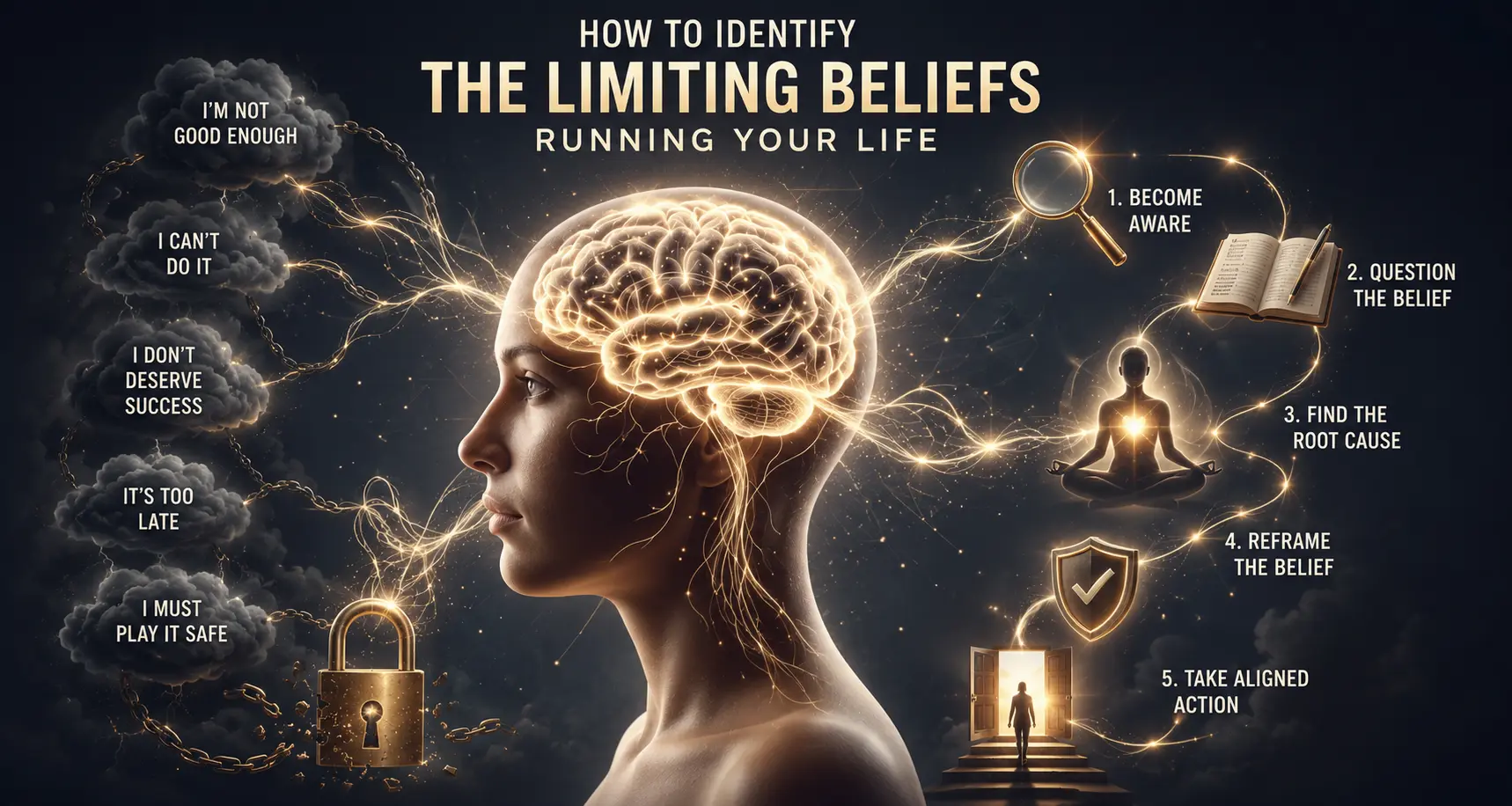
The beliefs most worth finding are the ones you don't know you hold. They surface not in what you say you want, but in what you repeatedly do, or avoid.
Try this structured diagnostic:
Step 1: Name the Gap
Write down one goal you've held for over a year without meaningful progress. Be specific: not "be healthier" but "exercise four times a week."
Step 2: Trace the Behavior
List every action you took toward it last month. Be honest. The gap between intention and action is where the limiting belief lives.
Step 3: Ask the Origin Question
Finish this sentence: "People like me don't ___." Whatever completes it is likely an inherited belief absorbed from a parent, a failure, or a loss, not a fact.
Step 4: Check the Secondary Gain
Ask: "What does staying stuck protect me from?" Failure? Judgment? Outgrowing someone you love? Subconscious patterns often exist because they served protective or adaptive functions in past circumstances. Recognizing that function is what makes them moveable.
Common examples: a client who says she wants financial abundance but unconsciously equates money with conflict, absorbed from parents' arguments. Another who wants a relationship but subconsciously believes intimacy leads to loss. These aren't character flaws, they're programs. And programs can be rewritten.
If you recognize yourself in these patterns, the deeper guide on why you feel stuck in life is worth reading before moving to the next phase.
The Three-Phase Method to Rewire Your Subconscious Mind
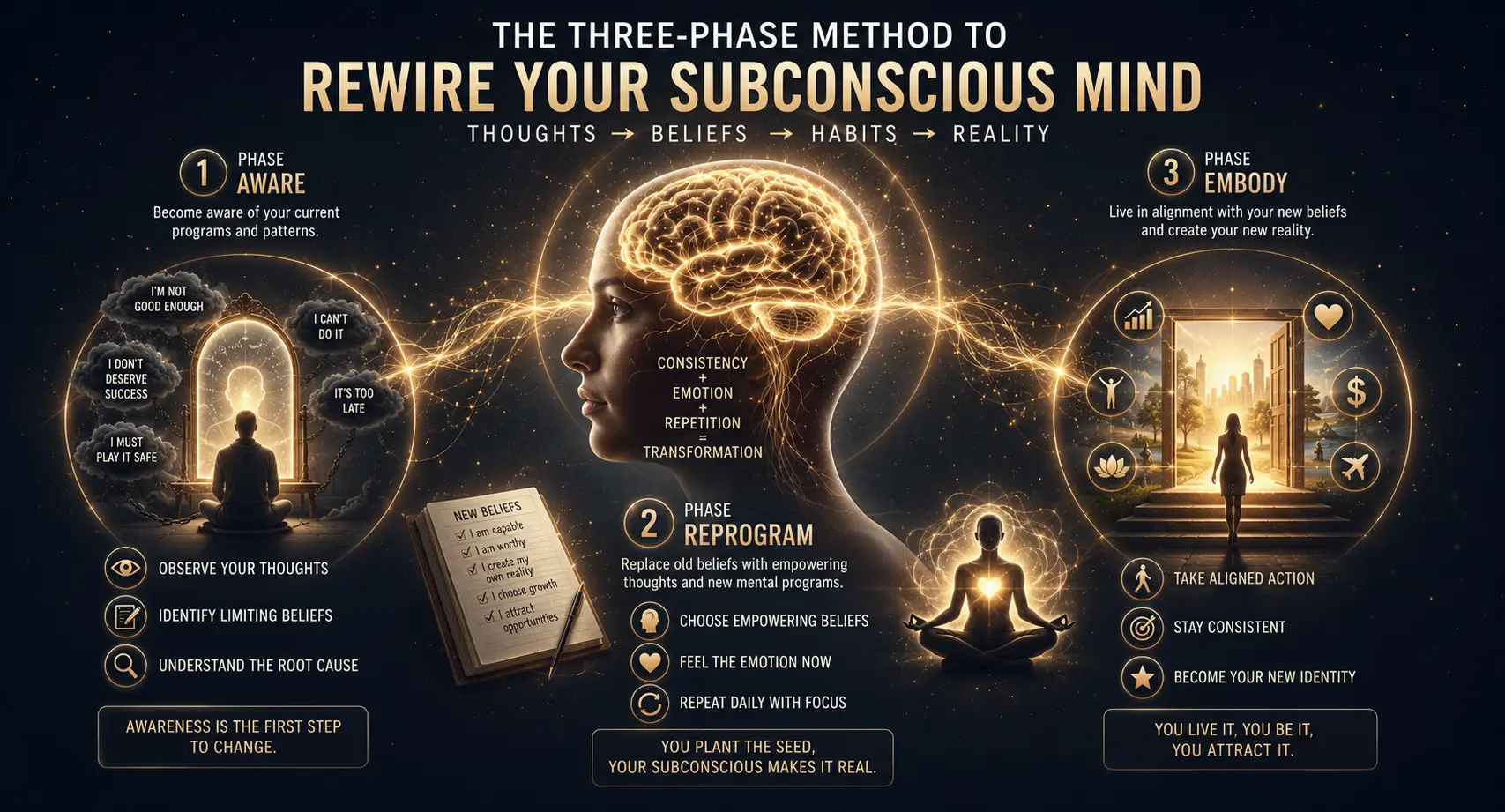
A structured approach consistently outperforms generic mindset coaching advice. The method below, Awareness, Reprogramming, Integration, reflects the sequence used in serious transformational coaching work, including the SoulPrint Method developed by Kathy Khodi-Elhami at Mind Alchemy Coach.
Kathy's SoulPrint Method draws on her software-engineering background and influences including Wayne Dyer and Zoroastrian philosophy; it is not a direct adaptation of Tony Robbins' framework, which focuses on high-energy behavioral motivation rather than subconscious identity redesign.
Three-Phase Method for Your Subconscious Mind
- Awareness — surface the belief and its origin. The common sticking point is mistaking symptoms for the root cause. You know it worked when you can name the belief without defending it. Minimum practice: 15-minute daily journaling for at least 2 weeks (about 1 hr 45 min/week).
- Reprogramming — replace the belief at the subconscious level. The common sticking point is using affirmations without emotional charge. You know it worked when new behavior emerges without forcing it. Minimum practice: 3x guided hypnosis or deep-meditation sessions per week (30-45 min each).
- Integration — anchor the new identity across contexts. The common sticking point is reverting under stress. You know it worked when the old trigger no longer produces the old reaction. Minimum practice: 1 deliberate stress-exposure exercise per week (e.g., a difficult conversation or high-pressure scenario practiced in a supported setting).
Phase 1 — Awareness
Awareness is where most people rush. The work here is not just naming a belief but feeling its weight. Through techniques such as mindfulness, visualization, and cognitive behavioral therapy, individuals can consciously influence subconscious patterns, practices that promote the formation of new neural pathways, allowing for the replacement of limiting beliefs with more empowering ones. But awareness alone doesn't create the new pathway. It only clears the ground.
Phase 2 — Reprogramming
Reprogramming is where hypnosis coaching and subconscious reprogramming techniques earn their place. The brain is most receptive to new belief installation in states of relaxed focus, the same neurological window that hypnosis, deep meditation, and certain breathwork practices open. This is the phase where working with a subconscious reprogramming coach accelerates what solo practice struggles to reach. The detailed mechanics of this phase are covered in the guide on how to reprogram your subconscious mind.
Phase 3 — Integration
Integration is the phase most coaching programs skip entirely. New beliefs must be stress-tested across real-life contexts, difficult conversations, financial pressure, relationship friction. Without deliberate integration, the old pattern resurfaces under load. This is also where self-identity coaching becomes essential: the goal isn't just a new behavior, it's a new self-concept that holds under pressure. If self-sabotage keeps breaking the cycle, self-sabotage coaching addresses the specific mechanism behind that relapse.