How to Stop Negative Thinking and Create Positive Habits

Kathy Khodi-Elhami
Transformational Subconscious Coach
Negative thinking and positive habits are directly linked: you cannot reliably build one without dismantling the other. The brain's threat-detection system keeps recycling distressing thoughts automatically, which is why willpower alone fails. Interrupting that loop at the subconscious level then anchoring a replacement habit is how to stop negative thinking and create positive habits that hold.
Key Takeaways
- Negative thinking loops are neurological, not moral failures, they require subconscious reprogramming, not willpower.
- The interruption point is the physical trigger before the thought itself, not the thought itself; timing is everything.
- Forcing positivity before interrupting the old pattern is the most common mistake and actively reinforces the loop.
- A habit that collapses under stress hasn't been anchored at the belief level, that's the diagnostic signal.
- Health, fitness, and social anxiety habits fail most often because the subconscious narrative hasn't changed, only the behavior.
Why Negative Thinking Feels So Hard to Break
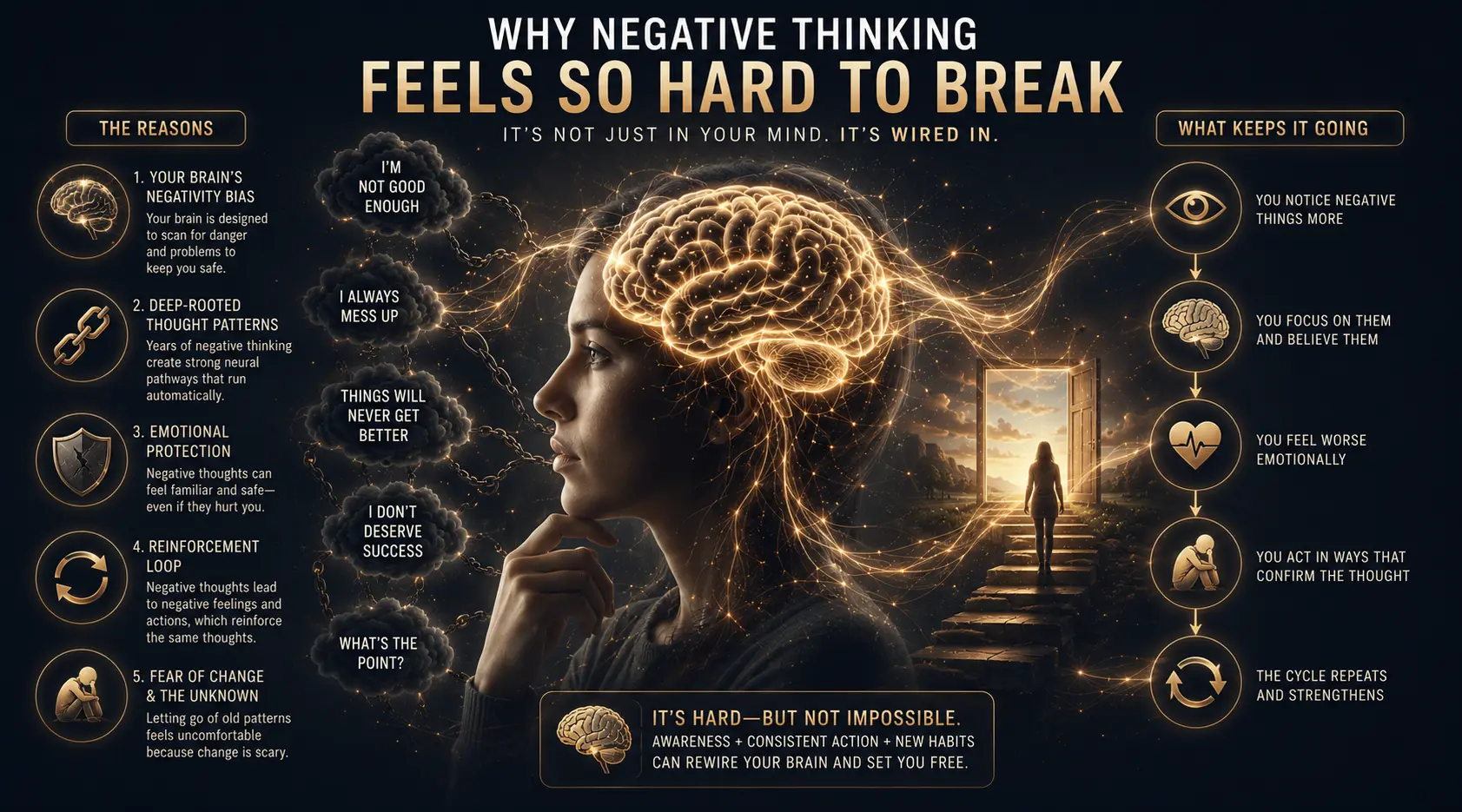
The short answer: your brain is doing exactly what it was designed to do, just in the wrong direction. Repetitive Negative Thinking (RNT): a transdiagnostic process encompassing rumination and worry, consistently identified as a core mechanism underpinning anxiety, depression, and other emotional disorders. Rumination tends to center on past events and personal flaws, intensifying self-critical cycles.
Why Your Brain Keeps Replaying Negative Thoughts
Here's the mechanism that makes it sticky: neuroimaging research identifies clusters within functional brain networks implicated in self-referential thinking, memory retrieval, emotional memory, cognitive control, and salience detection as the shared architecture of both worry and rumination. In plain terms, the same threat-detection circuitry that kept your ancestors alive keeps replaying your worst moments on a loop.
Prolonged rumination predicts higher anxiety severity, impaired sleep quality, and reduced psychological resilience. That's the health cost, and it's why negative self-talk sabotages sleep routines, exercise follow-through, and social confidence before you've even consciously decided to act.
Why Positive Thinking Alone Doesn't Break the Cycle
Positive affirmations and raw willpower fail here because they operate at the conscious level, while the loop runs subconsciously. Research into habit formation science consistently reveals that habits cannot simply be "erased," they must be replaced. The same principle applies to thought patterns. Subconscious reprogramming, not surface-level positivity, is the required lever.
The Three-Phase Method to Interrupt Negative Thoughts and Anchor New Patterns
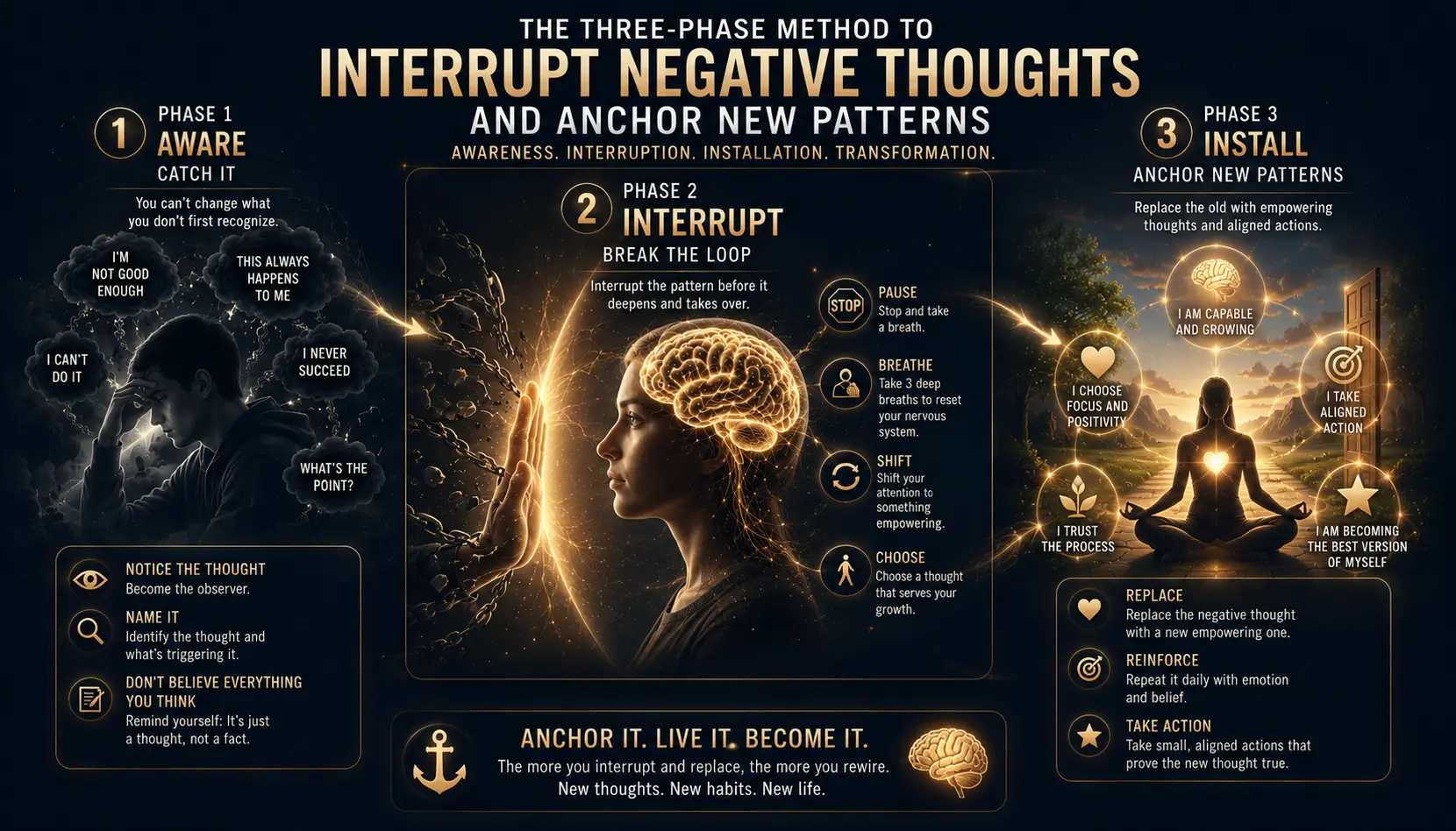
This is the core of how to stop negative thinking and create positive habits, a precise, sequenced approach where timing matters more than intensity.
Phase 1 — Recognize the Trigger in Real Time
Most people try to fight the thought after it has already flooded their system. The actual intervention point is earlier: the physical sensation that precedes the thought. A tightening chest before a social event, a drop in energy before a workout. Name the trigger out loud or in writing: "I notice I'm telling myself I'll fail before I've started." Naming it activates the prefrontal cortex and briefly interrupts the automatic loop.
Phase 2 — The Subconscious Interruption Exercise
The key lies in manipulating the cue-routine-reward loop by identifying the original triggers and substituting the routine with a healthier action that produces similar rewards.
In practice: the moment you catch the trigger, use a pattern interrupt, a sharp breath, a physical gesture, or a single anchoring phrase, to signal to the nervous system that the old response is no longer automatic.
This is where hypnosis coaching and subconscious reprogramming techniques are most effective, because they access the subconscious layer that conscious effort cannot reach.
Why Specificity Matters
The non-obvious nuance: specificity beats intensity. A vague instruction to "think positive" does nothing. A precise replacement thought, "I have prepared for this; I act anyway," tied to the exact trigger, rewires the pathway. Forcing positivity before the old pattern is interrupted is the most common mistake, and it actually reinforces the loop by adding a layer of self-judgment when the forced positivity fails.
Phase 3 — Anchor the Replacement Habit
You can stack this strategy with implementation intentions, "if-then" statements that guide behavior in specific situations. For example, "If I feel stressed, then I will sip chamomile tea." Research finds implementation intentions to be an effective means of guiding behavior toward goals and overriding bad habits. Repeat the replacement response across at least 30 consecutive trigger events. Repetition is what shifts the pattern from conscious effort to subconscious default.
How Different Approaches Compare
- Willpower / affirmations — Focus: conscious mind. Mechanism: suppression. Limitation: doesn't reach the subconscious loop. Best for: mild, situational negative thoughts.
- Talk therapy — Focus: insight and narrative. Mechanism: cognitive reframing. Limitation: can miss the embodied/identity layer. Best for: insight-driven change with a trained clinician.
- Generic mindset coaching (e.g. Tony Robbins) — Focus: motivation and behavior. Mechanism: high-energy pattern interrupt. Limitation: mass-market, not precision-calibrated. Best for: motivation and behavioral momentum.
- Subconscious reprogramming (e.g. SoulPrint Method) — Focus: identity and belief. Mechanism: hypnosis-based loop interruption. Limitation: requires consistent repetition cycles. Best for: recurring identity-level loops that resist conscious effort.
How Do You Build Habits That Stick?
New habits fail when the behavior changes but the underlying belief doesn't. That's the gap between intellectual understanding and embodied change, and it's where most self-improvement efforts collapse.
Why New Habits Often Don't Last
Social psychologist Wendy Wood at the University of Southern California found that an astonishing 43% of daily actions are enacted on the basis of habit (Wood & Neal, 2007).
That means nearly half your day is running on subconscious autopilot.
Layering a new positive habit onto an uninterrupted negative belief is like installing new software on a corrupted operating system, it crashes under pressure.
Where Negative Beliefs Show Up in Everyday Life
Health and wellness contexts are where this shows up most clearly. Negative self-talk around fitness ("I always quit") sabotages exercise follow-through within days.
Poor sleep is frequently driven by rumination loops that activate the moment the body slows down. Social anxiety creates avoidance habits that feel protective but deepen isolation.
In each case, the surface habit (going to the gym, a bedtime routine, attending a social event) is not the real problem, the subconscious belief driving the exit behavior is.
A Mini-Framework for Testing Whether a Habit Is Actually Anchored
Stress Test It
Does the habit hold on a bad day, or only when conditions are ideal? A surface-level habit evaporates under pressure; an anchored one persists.
Check the Internal Narrative
Before the habit, what do you tell yourself? If the self-talk is still negative, the belief hasn't shifted, only the behavior has.
Notice the Effort Level at Week 6
A 2024 meta-analysis found it is a myth that most people form a lasting habit in 21 days. Research shows it typically takes 2 to 5 months to develop health-related habits.
If a habit still feels like a fight at six weeks, the subconscious layer needs more direct work.
When Coaching Can Help Reinforce New Habits
Working with a mindset transformation coach or a structured self-sabotage coaching program addresses the belief layer directly.
Kathy Khodi-Elhami's SoulPrint Method, a proprietary 3-phase framework that blends software-engineering precision with subconscious work informed by Wayne Dyer and Tony Robbins, is one structured approach to this.
Note: the SoulPrint Method is Kathy's own proprietary system; it is influenced by thinkers like Robbins and Dyer but is not a derivative of their frameworks.
Why the Right Coaching Approach Matters
Transformational coaching and mindset coaching approaches like BetterUp offer scientific validation and data-driven models with strong corporate mindset authority, but tend to focus on behavioral performance rather than deep identity and subconscious redesign.
The distinction matters when the habit keeps failing despite genuine effort, that's a subconscious signal, not a willpower problem.
For a deeper look at the behavioral patterns that keep this cycle running, the guide on how to stop self-sabotage is a useful companion read.